
The Fleetwood Flood
THE FLEETWOOD FLOOD By Nicola Crawford This article was written as part of the ‘Lancashire and Puppetry’ project supported by the National Lottery Heritage Fund and Lancashire County Council. The Fleetwood community of caravan dwellers inspired part of the 2024 performance ‘Clomping About’.
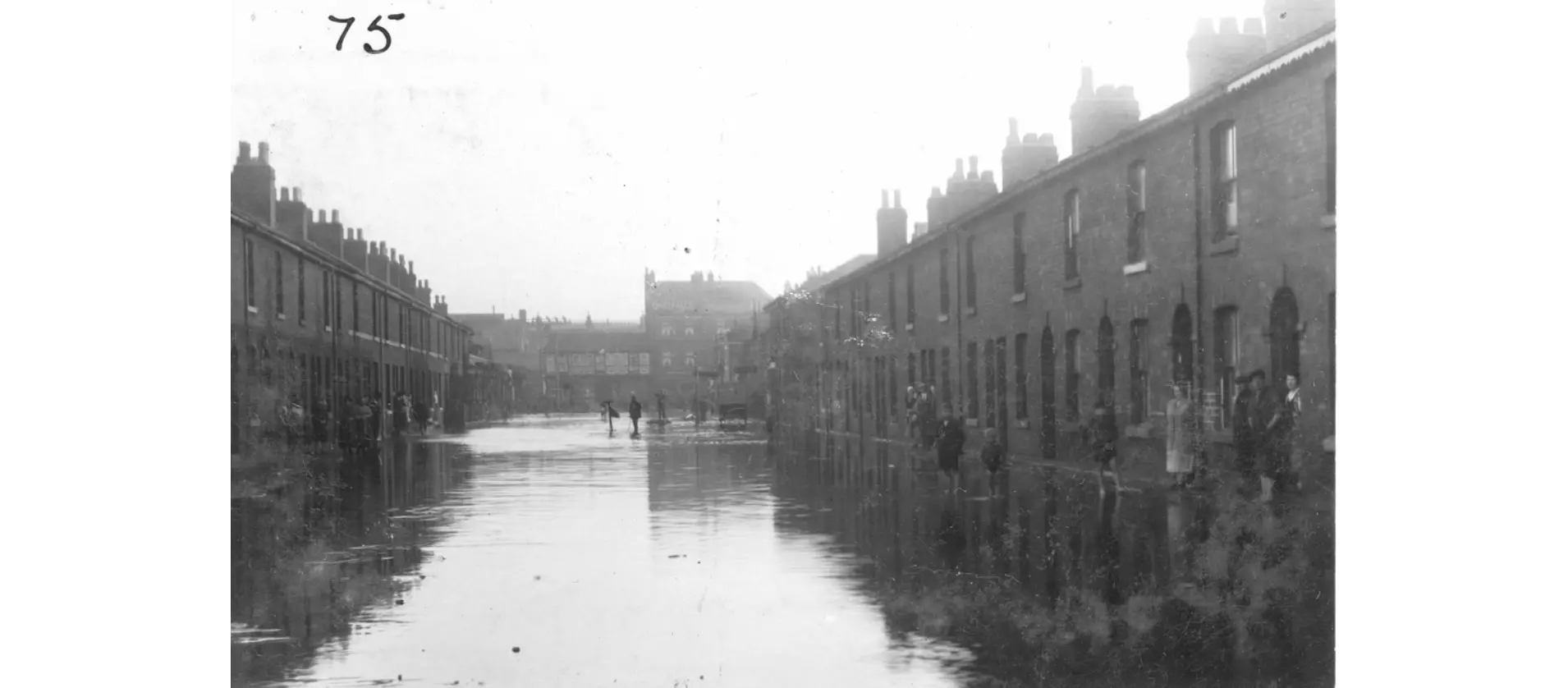
Photo Credit: LCC Red Rose Collection
On the evening of 28 October 1927 a storm hit the Lancashire coast with a south-westerly gale of 80mph, raising the tide from its normal 25ft to 32ft 6in. The whole of the coast was affected but none so bad as the town of Fleetwood. The water broke through the sea wall and transformed Fleetwood into an immense lake, flooding the streets with 3-12ft of water. The roads and railways were blocked, isolating the town.
The electricity works were flooded, plunging the town into darkness. A scrapbook of newspaper cuttings from Lancashire Archives details the work of Superintendent Crapper during the flood and the experiences of ordinary people. A selection of the many stories found in this scrapbook highlight the experiences of people during the flood which is described to have been the worst urban disaster in the Northwest of England. In a population of 22,000, 10,000 were affected; the hardest hit were caravan dwellers living in the lowest part of town. Using the scrapbook and newspaper articles, light has been shone on the lives of caravan dwellers living in Fleetwood during the flood and beyond.
About the Flood
On the evening of the storm, many families woke to the sound of rushing water flooding their downstairs rooms. They would have gone into a frenzy trying to grab food, candles, and belongings before running back to the safety of the upstairs. Those who did not wake up in time to salvage items from the ground floors were left fireless, foodless, and drenched to their skin. The furniture of the lower rooms could be heard floating and bumping against the ceilings and window frames. On 29 October, 1,123 houses were visited, and the occupants rescued. Not all survivors could be rescued immediately.
Those trapped in the upper rooms were told to attach clothes lines from the windows for baskets of food, drink, and occasionally candles and oil lamps, to be passed up. The candles and oil lamps provided light to those trapped in their houses and were used to guide rescue boats to them in the darkness. By 2 November, people began to return to their homes following news that the waters were subsiding. Only three of the 37 submerged streets were impassable to pedestrians at this point. Left behind on the cleared streets was slimy, evil smelling mud, several inches deep; a reminder that it was not business as usual.
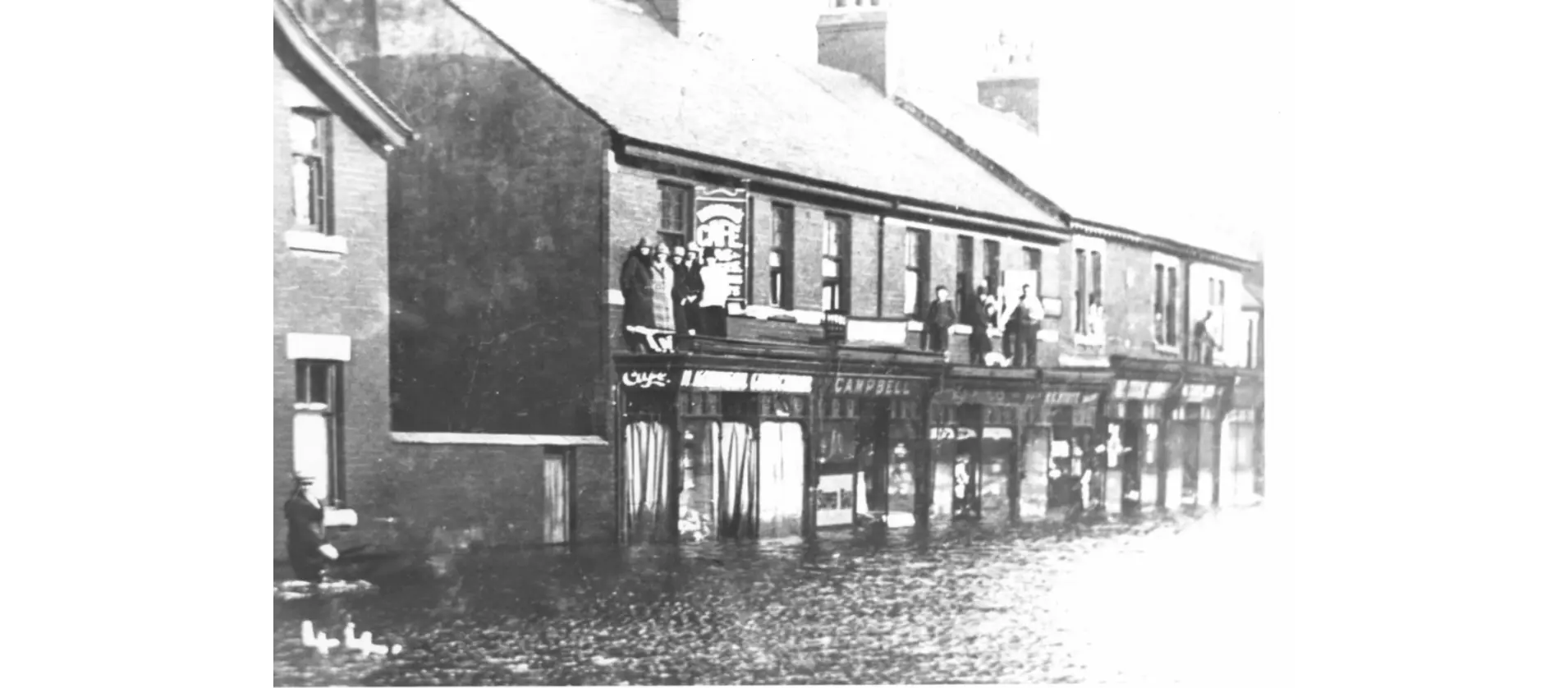
Photo Credit: LCC Red Rose Collection
The flooded area of the town was still without power, the darkness making the town appear to be in mourning. 100 yards from the flooded area, St Margaret’s Church became the primary refugee point. Hot drinks and dry clothes were distributed, and beds were laid out for those who needed them, converting the space into a temporary home.
An important figure in the flood was Superintendent Crapper, dubbed ‘the hero of Fleetwood’s floods’. He requested that neighbouring towns send small rowing boats to Fleetwood to help them navigate the flooded streets. Crapper coordinated rescue parties and even went out on some, helping rescue seven policemen and their families. He also worked with his wife to organise the collection and distribution of aid to the victims, transforming the police station into a clothing and food depot. Clothing donations were so great in number that they filled not only the police station but the courtroom, magistrates’ bench, and the dock.
Calls were made for children’s clothes to be donated as well as toys with Christmas fast approaching. Families could not afford to repair and replace their homes and belongings, let alone buy presents. There were also requests for items for expectant mothers, such as baby clothes and prams. The calls for donations were nationwide, featuring in newspapers and even on the BBC, with people of all ages responding. A young girl from Manchester sent Superintendent Crapper a sixpence for the relief fund, explaining that she had been saving it to buy fireworks to celebrate Bonfire Night but believed the victims of the flood needed it more. The relief fund totalled just over £107,000. This was used to issue vouchers to households to purchase furniture, household utensils, linen, drapery, bedding and clothing, new or second-hand, for them to repair their homes.
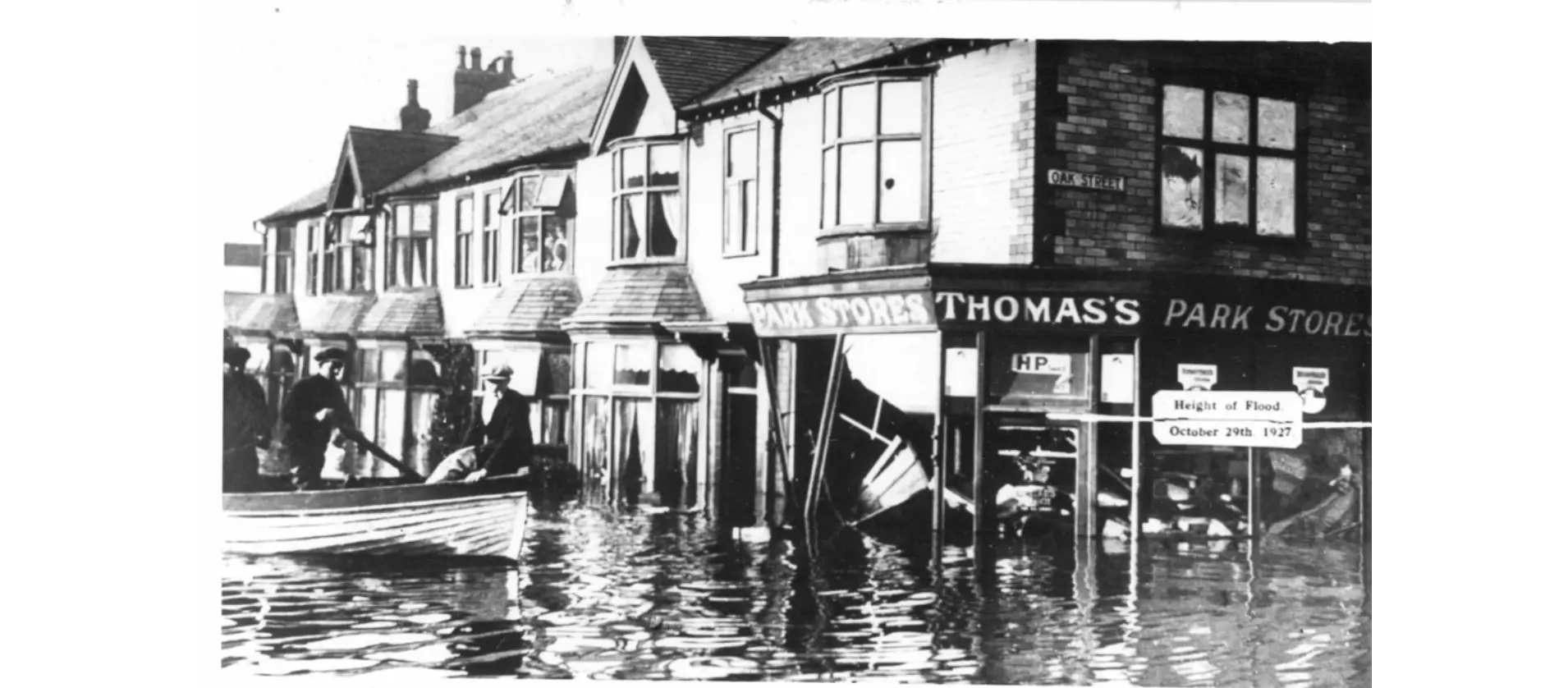
Photo Credit: LCC Red Rose Collection
Unfortunately, these vouchers were not issued to caravan dwellers. Amidst the horrors of the flood, a strong sense of community was created with neighbours helping one another and doing what they could to raise spirits. A man in Addison Road put a gramophone on his windowsill and played his records to cheer up his neighbours, offering some music and singing as they waited for the small boats to rescue them. Some did not want to wait for the boats. A man named Walter J Scott Jr constructed a raft to rescue his sister and her two children (six and five weeks). After getting them to safety he returned on his raft to the house to rescue his mother, cats, and parrot. The raft broke but determined, he waded through the water to get them to safety. This ingenuity was not limited to adults with fourteen-year-old Magnus Gordon also building a raft out of floating backdoors and fish boxes to bring his grandmother and kitten to safety.
Magnus did not stop there but went back to help a man named James Durkin and his landlady. Not all pets were rescued, with many swept away or left waiting for their owners to return. Some made it to safety all on their own; it was reported that two cats made their way to the police station and took up residence there. Surprising stories of children emerge, the ‘Babies of the Storm’. These were three children who were born in the flood, two on the night of and one three days later. It was reported that one mother gave birth in the top rooms of her flooded house whilst waiting to be rescued. Another was born in a rescue boat as the mother was taken to safety. Despite the chaos of the flood, these children were born healthy and delivered safely.
Caravan Dwellers During the Flood
The devastation of the flood was felt hardest by the caravan dwellers. The caravan colony was in the lowest part of the town, the Warrenhurst district, making them the most at risk. The caravans were untethered homes, easily swept away in the waters; Magnus reportedly saw nine floating past him on his raft. Caravans were flooded, overturned and, in some cases, smashed to pieces in the brutal storm. Police, local authorities, and local fishermen were directed to the Warrenhurst district first to rescue survivors. The colony was filled with large families but also new ones, with many newlyweds pouring their savings into a caravan for their first home as a married couple. There were six fatalities in the Fleetwood flood, five of these were caravan dwellers.
The non caravan dweller was William Henry Banks, 33, believed to have been walking home when he was caught up in the flood and drowned. Of the caravan dwellers was Mrs Lily Bailey and four members of the Chard family. It is believed that the Chard family was one of seven members, only three of whom survived the flood. They opened the door of the caravan to three feet of water and were instantly separated. The father, Charles Chard, a steam trawler’s mate, was separated holding his youngest Ellen. He swam with Ellen in his arms until exhaustion overcame him and he collapsed, leaving Ellen to float along in the flood and drown. His eldest son Charles Chard survived, as did a daughter, Mary. Mary is not found in any reports of the flood; it is thought that she was not in the caravan when the flood hit. It is known that she survived because of a report detailing the funeral of her mother Mrs Mary Chard, her brothers James Edward and Frederick, and her little sister Ellen, where she is described collapsing in grief.
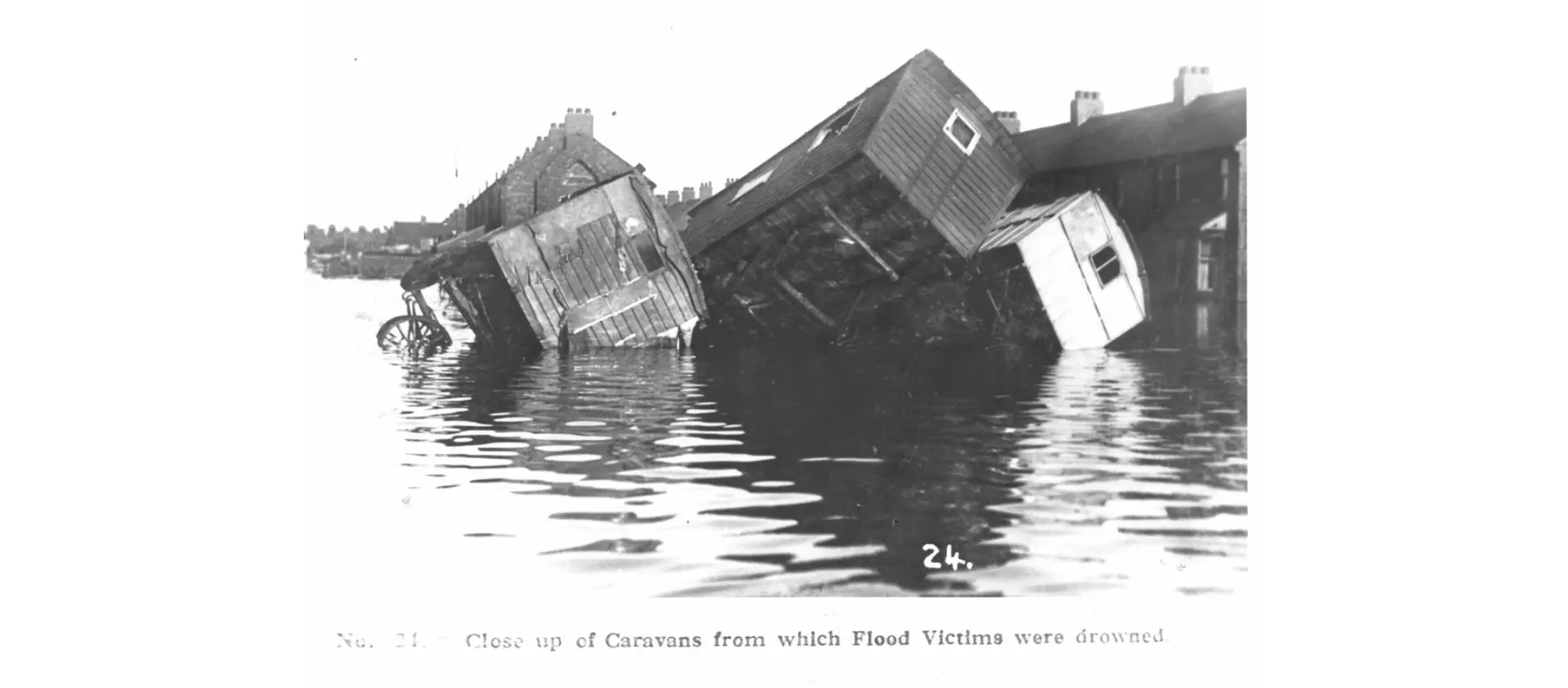
Photo Credit: LCC Red Rose Collection
Neighbours to caravaners rushed to their aid. Dan Carrellan reportedly ushered 20 people into the upper rooms of his house before the on-rushing flood, largely caravan dwellers and children. Mr Farrington, his wife and their son awoke to the sound of their hen-cabin being flung fifteen yards way by a strong gale. They rushed out of their caravan to seek refuge at a neighbour’s house, which flooded ten minutes later.
The group were rescued the following morning, finding the Farrington’s caravan and their belongings destroyed. There is also the heroic report of an unknown man who swam for four hours around a caravan in a successful attempt to rescue a woman and her fortnight old baby from their caravan. There are plenty more stories of ordinary people helping the caravan colony. Equally there are reports of caravaners helping save others from the flood. A group of unnamed male caravaners were seen throwing stones at the windows and doors of neighbouring houses and caravans to wake families up to the flood. They also carried children on their shoulders through the submerged streets and climbed lamp-posts and walls to catch people carried away in the water. All these people were taken to refuge points.
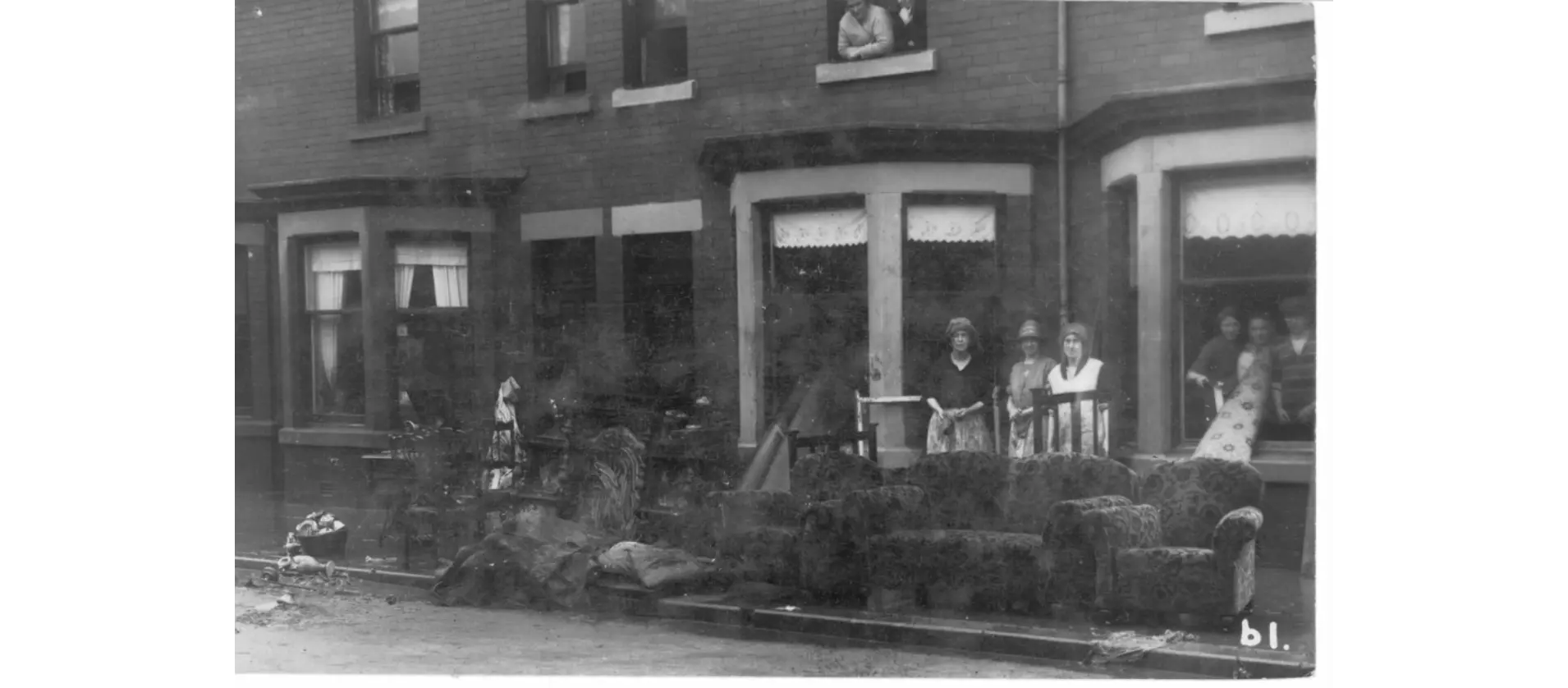
Photo Credit: LCC Red Rose Collection
By the time most caravaners awoke to the noise of water, it had risen too high to open their door and escape their caravan. Many were left to climb out of windows onto the roof and sit there in the storm until it subsided, and they could be rescued. For some this was a matter of hours but for others it meant days. One reportedly escaped his home with his six children at 11pm on the night of the flood, leaving them sitting on the top of their home for two days until they were rescued. The strong winds and waters caused many caravans to overturn, and whilst occupants were heard shouting for help, it was impossible to rescue them until the water subsided. Mrs Slater and her four children, ranging from six years to two months, lived in a rather heavy caravan which withstood the force of the storm and did not overturn.
They were able to sit on the bed and wait until small boats arrived to help them all out of their window and to safety. Mr and Mrs P Phillips got stuck in their caravan. Unlike the Slater family they lived in a light caravan and were hurled half a mile in eight hours before being able to get to safety. Their dog Floss was able to escape the caravan and remained at the site for five days until the couple returned to rescue her. Bernice, a customer at Fleetwood Library in 2024, told the story of Nora Swales. Nora was married at sixteen to Arthur Swales and went to live in a caravan which she was in at the time of the flood. Now aged 20, Nora sought refuge on the roof of her home with two young children and was rescued by her husband. As was the case with a number of caravan dwellers, Nora and her family were rehoused in Fleetwood. She lived till the age of 90 with more than 100 grandchildren and great-grandchildren.
What Happened to Caravan Dwellers After the Flood?
Unlike Nora, not all caravan dwellers could be allocated a house or flat after the flood. Once the waters subsided and the site was accessible, caravans were inspected to assess the level of damage sustained. Those deemed reparable were allocated timber to do so. In the instances where caravans had been completely destroyed, temporary accommodation was provided until a permanent home could be found. Whilst the town of Fleetwood rallied to help the caravan dwellers after the flood, newspaper reports suggest that they were not welcomed members of the community by the local council. The travelling community in Fleetwood was primarily comprised of people who could not find proper accommodation, so had to create a home for themselves. This was primarily a result of the housing shortage after the First World War. Many councillors did not approve, seemingly making it their mission to remove caravan colonies. Few living in caravans did so because they enjoyed the lifestyle but because they did not have a choice, with many rejected applications for council houses.
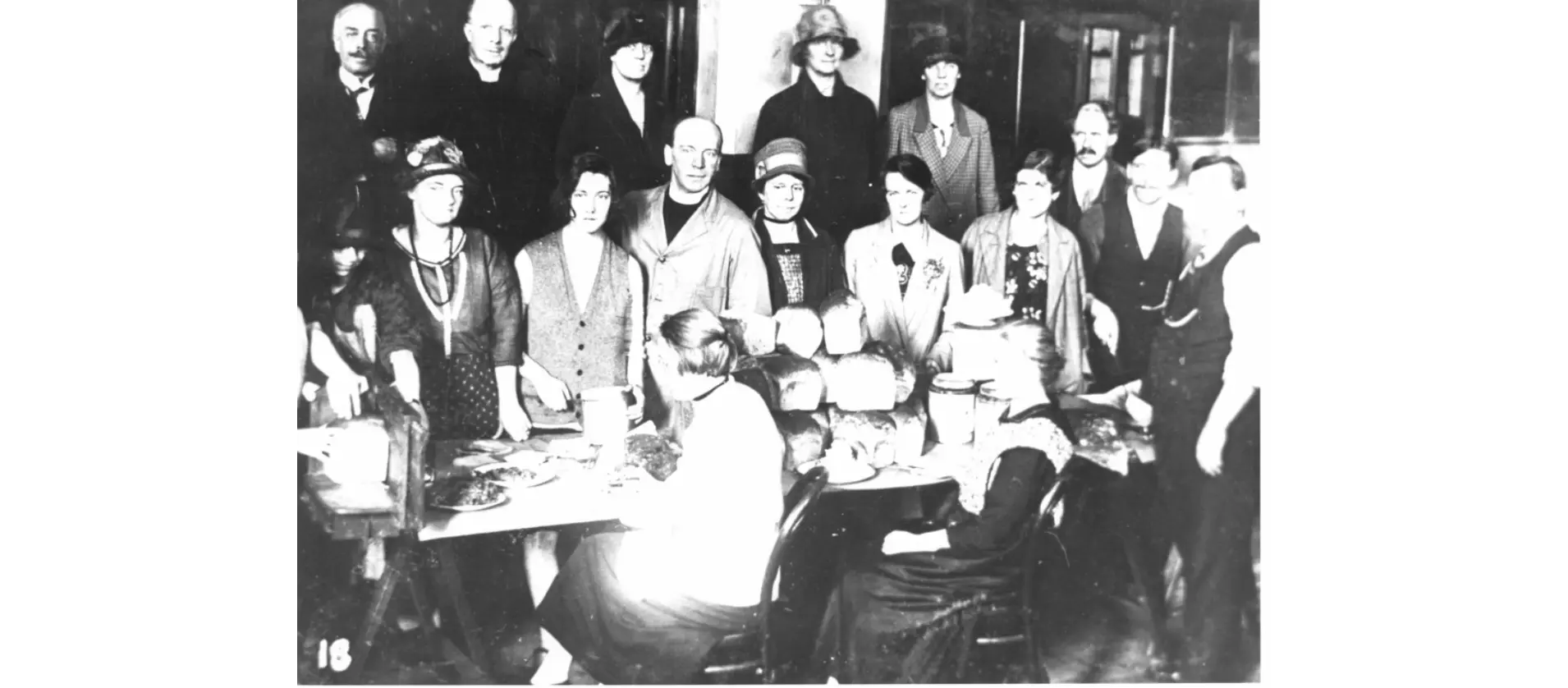
Photo Credit: LCC Red Rose Collection
Prior to the flood in 1927, the Fleetwood Improvement Act was introduced which ordered the removal of caravans from certain sites in Fleetwood. Whilst the enforcement of the Act appears to have been delayed because of the flood, the desire to remove the caravan colony did not lessen. This is reflected in the distribution of financial aid; homeowners received vouchers from the relief fund to buy furniture and other household items to restore their homes, but caravaners did not. Two years after the flood the attempts to remove caravaners were renewed under the guise of concern for public health. It became policy that when someone vacated a caravan it had to be inspected by the council to ensure it was habitable before allowing a new occupant. This was essentially a method of removing caravans without ordering people out.
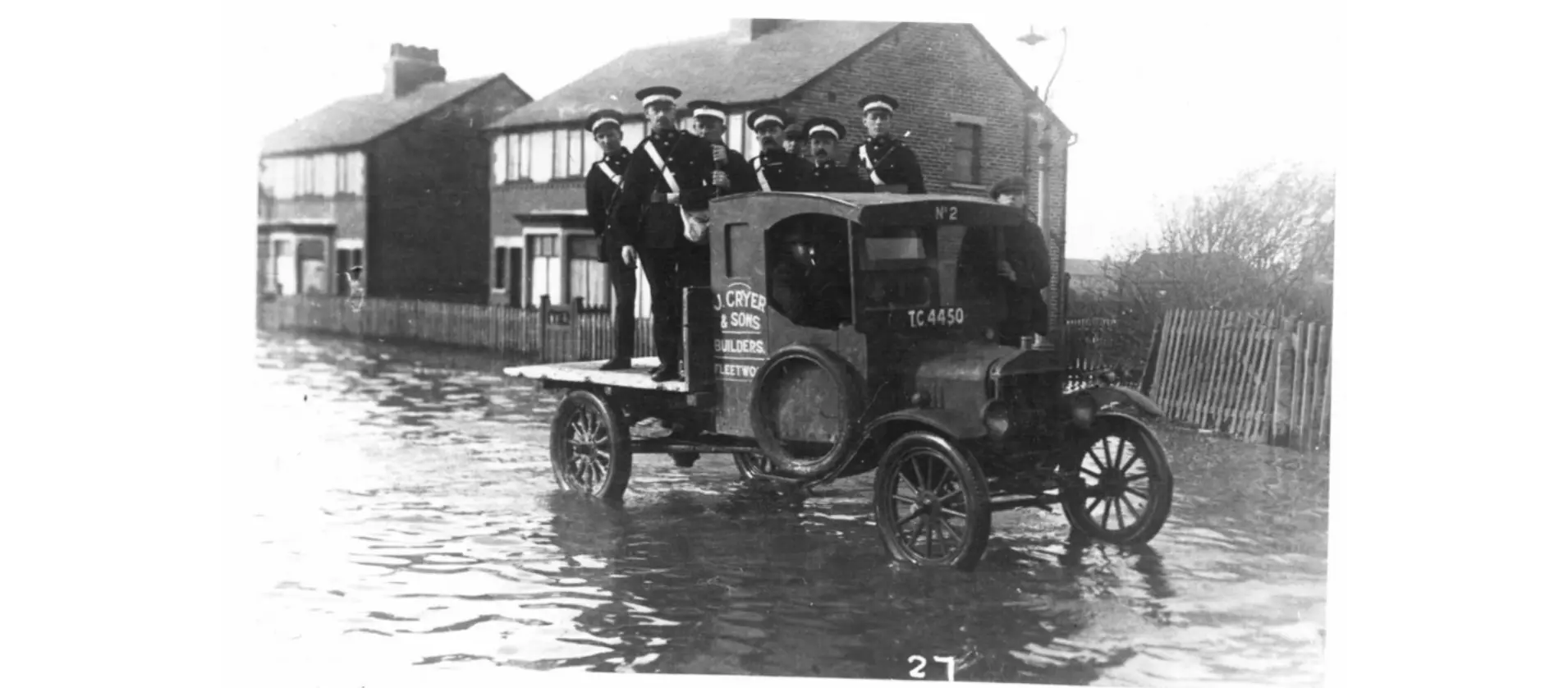
Photo Credit: LCC Red Rose Collection
The number of caravan dwellers did decrease as the years progressed; in 1929 there were 60 caravans and huts which was reduced to twenty by 1932. The caravaners did not go quietly, the best example of these being Arthur Eggett. Mr Eggett contested the claims that the caravans were being removed in the interests of public health, arguing that in the 30 years he had lived in a caravan, travelling all over the country, he had never known a caravan dweller, ‘to have consumption, asthma, or tuberculosis… as their motto is cleanliness, fresh air, and pure food.’ In a newspaper article in December 1933, it was proclaimed that Fleetwood was 100% free of caravan dwellers, with one exception, Albert, who commented that he had no means of leaving Fleetwood, unless someone would buy him a horse to carry his cart away. Eventually, he was able to get a house, thus marking the end of the caravan colony.
Albert was found in an article about his dog Nell. Nell reportedly bit two people. A court ruled that she had to be muzzled and kept in the house, or put down. It was decided that Nell would be kept in the house as she was vital to Albert. She would wake him up in the mornings, pulling on a string to boil the kettle for his morning brew, and greet him upon his return home with his slippers at the door. The story of Nell and Albert reached Vancouver and Switzerland, resulting in Nell being sent a sausage and Mr Eggett a tin of meat for Christmas by some ‘Swiss girls’. Albert resided in Fleetwood until he died on 14 July 1951, eleven days after the death of Nell. The Fleetwood Flood had a longstanding impact upon the residents of the town. A new seawall was constructed, possessions were replaced, houses rebuilt, and caravans were eventually removed. Researching the flood has uncovered these spectacular stories of survival and community, shining through the horror of the flood.
Sources
Fleetwood floods, correspondence and newspaper articles about Francis Crapper’s MBE award to recognise his work at this time, DDX/3187/9/3, Lancashire Archives & Local History
British Newspaper Archive
‘Floods in Northwest England: A history c.1600-2008’, available at Lancashire Archives & Local History and Fleetwood Library ‘Fleetwood: a town is born’, available at Lancashire Archives & Local History and Fleetwood Library ‘Fleetwood Public Libraries, The Flood of 1927’, compiled by P Doughty, available at Lancashire Archives & Local History and Fleetwood Library
Minutes of the Fleetwood Urban District Council, 1927-1928, Fleetwood Library
Explore more Social and Community stories below
The History of Hillhouse International Business Park
The History of Hillhouse International Business Park
Fold House Park – from farming to agritourism
Fold House Park – from farming to agritourism
The Tolls for the Old Shard Bridge
The Tolls for the Old Shard Bridge
The Fleetwood Flood of 1927
The Fleetwood Flood of 1927
The Fleetwood Fishing Queen
The Fleetwood Fishing Queen
Pioneering women of the 20th Century